

Written by: Hock Star Direct Contractor Team (20+ Years Landed & Commercial Experience) Last Updated: April 2026
Boundary Wall Singapore: Boundary Wall Singapore in Singapore — this guide covers everything you need to know for a successful outcome.
- Understanding boundary wall singapore helps avoid costly mistakes
- HDB and BCA regulations apply — always verify compliance
- Using a licensed contractor (Hock Star) ensures quality and accountability
The Bottom Line (BLUF)
Constructing or modifying a boundary wall for a landed property in Singapore costs between $150 to $300+ per foot run (pfr), depending on the height, materials, and foundation required. All boundary wall works must strictly comply with URA (Urban Redevelopment Authority) height limits and BCA (Building and Construction Authority) structural safety guidelines, requiring professional direct contractor execution.
Key Considerations for Boundary Wall Singapore in Singapore
Understanding Boundary Walls for Landed Properties
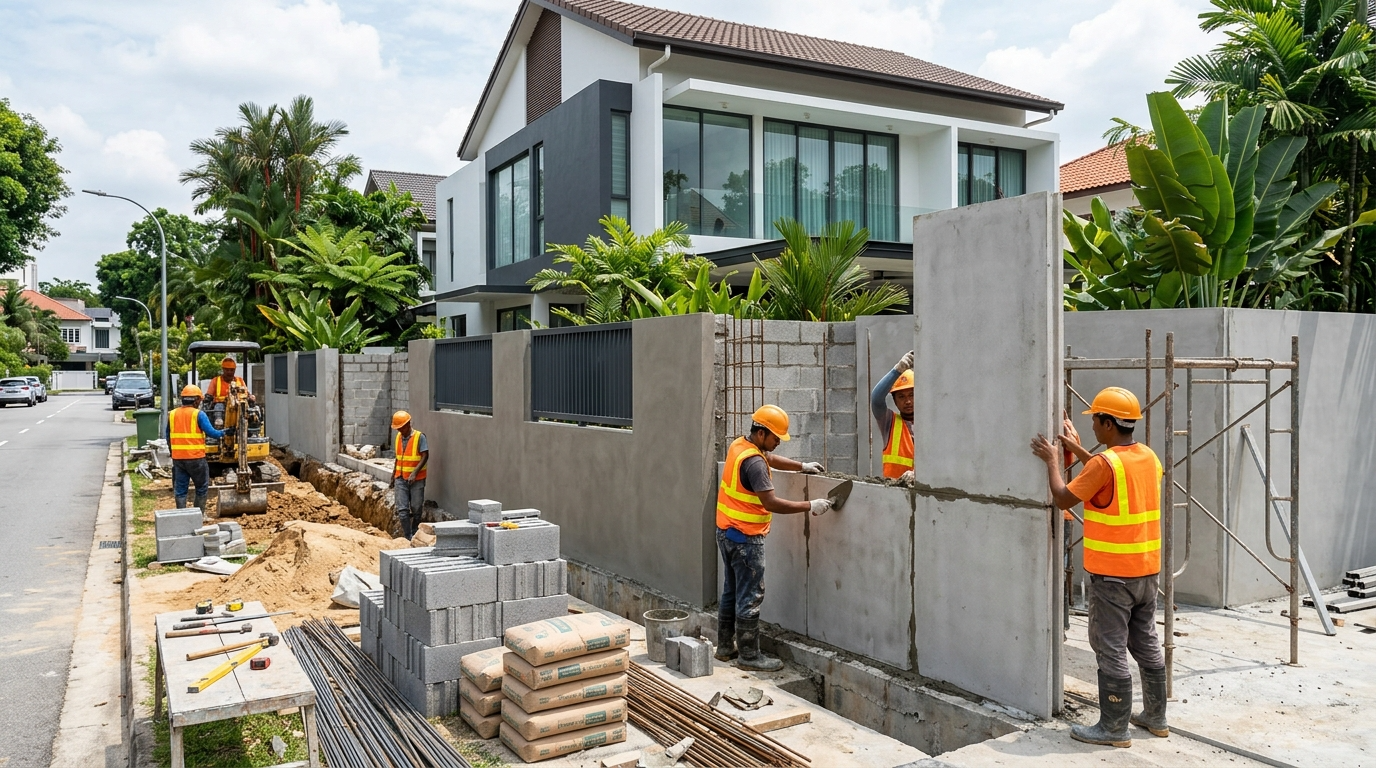
Unlike HDB renovations, exterior works on landed properties (Terrace, Semi-Detached, or Bungalows) involve complex civil engineering and strict government oversight.
A boundary wall serves as the physical dividing line between your property and your neighbor’s, or between your property and the public road. Because these walls must withstand soil pressure, heavy rain, and potential impact, they are heavily regulated.
Critical URA & BCA Regulations You Must Know
If you are planning to demolish, rebuild, or raise your boundary wall, your direct contractor must navigate the following legal frameworks:
- URA Height Limits:
- Front Boundary: Walls facing a public road are generally restricted to a maximum height of 1.8 meters. However, solid (opaque) walls are usually only allowed up to 1.5 meters, with the remaining 0.3 meters required to be porous (e.g., metal grilles) for visibility.
- Side/Rear Boundary: Walls dividing your property from a neighbor’s are typically allowed up to 1.8 meters in solid construction to ensure privacy.
- BCA Structural Endorsement: If your boundary wall acts as a retaining wall (holding back soil from a higher elevation), or exceeds specific height thresholds, the structural plans must be drawn and endorsed by a registered Professional Engineer (PE) and submitted to BCA for approval.
- The “Party Wall” Rule: A wall shared exactly on the boundary line between two semi-detached or terrace houses is considered a “Party Wall.” You cannot hack, modify, or rebuild this wall without the formal, written consent of your neighbor.
Boundary Wall Construction Costs (2026)
Boundary walls are priced differently than internal house walls. The cost includes deep trenching, concrete footing, steel rebar reinforcement, and exterior weatherproofing.
| Component | Estimated Cost | Notes |
|---|---|---|
|
Demolition & Haulage |
$2,000 – $5,000 |
Safe hacking of the old wall and heavy rubble removal. |
|
New Wall Construction |
$150 – $300+ Per Foot Run |
Includes reinforced concrete footing, block laying, and plastering. |
|
PE Endorsement & Permits |
$3,000 – $6,000+ |
Required for retaining walls or specific structural changes. |
Frequently Asked Questions (FAQ)
Can I build a boundary wall higher than 1.8 meters for security?
In most standard residential zones, URA strictly limits the height to 1.8m to maintain neighborhood aesthetics and ventilation. Exceptions are rare and require a formal planning appeal to URA.
Who pays for repairing a shared Party Wall?
Under Singapore law, the cost of repairing or maintaining a shared Party Wall is typically split 50/50 between the two adjoining property owners, unless one party caused specific damage to it.
Key Considerations for Boundary Wall Singapore in Singapore
What Should Homeowners Know Before Proceeding?
Singapore homeowners planning boundary wall singapore work should factor in HDB regulations, contractor licensing requirements, and realistic timelines. The HDB renovation portal outlines approved works, materials, and contractor requirements that apply to most residential projects.
Working with a licensed direct contractor like Hock Star removes the interior designer markup and gives homeowners direct accountability — typically saving 20-30% versus ID-coordinated projects of equivalent scope.
How Long Does It Typically Take?
Most boundary wall singapore projects in Singapore take 4-12 weeks depending on scope, permit requirements, and material lead times. HDB projects requiring permits add 2-4 weeks for approval. Engaging a contractor early in the planning phase ensures materials are ordered and permits processed before work begins, minimising overall timeline.
Practical Guidance for Singapore Homeowners
What Should You Verify Before Hiring a Contractor?
Before engaging any renovation contractor in Singapore, verify three things: their BCA licence number (check on the BCA contractors registry), their HDB registration status if your project involves an HDB flat, and their insurance coverage. A licensed direct contractor like Hock Star handles all compliance requirements and provides clear documentation from quote to completion.
Renovation costs in Singapore vary significantly based on scope, materials, and timeline. Getting 2-3 comparable quotes helps establish a fair market rate — but the lowest quote is rarely the best value if it cuts corners on materials or licensed tradespeople.
How Long Will Your Project Take?
Most Singapore renovation projects take 6-12 weeks from contract signing to handover. HDB projects requiring permits add 2-4 weeks for approval. Condo projects involving MCST approval add another 2-3 weeks. Planning your temporary accommodation and storage needs in advance prevents unnecessary stress during the renovation period.
Conclusion
Building a boundary wall is a major civil works project that requires precision, structural integrity, and flawless government compliance. A collapsing or unapproved wall can lead to severe BCA fines and neighborly disputes. By hiring an experienced direct contractor, you ensure the project is managed end-to-end—from URA submissions to the final layer of weather-resistant paint—without the massive markups of a boutique design firm.
Contact Hock Star Direct Contractor today for an on-site assessment and quotation for your landed property.
Disclaimer: The information provided in this article is for general informational purposes only. Construction costs, URA height regulations, and BCA structural requirements frequently change. Always consult a licensed Professional Engineer (PE) and a certified direct contractor for an accurate, localized assessment before beginning any exterior boundary works.