

HDB renovation in 2026 sits at the intersection of two powerful forces: a resale market that has driven prices up 9.7 per cent year-on-year, making renovation investment increasingly worthwhile, and a design landscape that has shifted decisively toward warmer, more material-rich aesthetics after years of white minimalism. Whether you are renovating a freshly collected BTO, refreshing a mid-cycle resale flat, or undertaking a full overhaul of an older unit, the ideas in this guide are grounded in what actually works in Singapore homes — spatially, climatically, and practically.
Hdb Renovation Ideas Singapore: Hdb Renovation Ideas Singapore in Singapore — this guide covers everything you need to know for a successful outcome.
- Understanding hdb renovation ideas singapore helps avoid costly mistakes
- HDB and BCA regulations apply — always verify compliance
- Using a licensed contractor (Hock Star) ensures quality and accountability
- Top 2026 design trends: Japandi, fluted panels, arched doorways, biophilic elements, warm neutrals
- Most impactful budget renovation: Feature wall + flooring refresh (from $5,000)
- Most impactful whole-home renovation: Full kitchen + bathrooms + living area carpentry ($50,000–$80,000 for a 4-room)
- Highest ROI renovation for resale HDB: Kitchen and bathroom upgrades
- Key rule: Good renovation rewards constraint and clarity — know your brief before you begin
The most common renovation mistake in Singapore is not over-spending — it is under-planning. Homeowners who enter a renovation without a clear spatial brief, a defined aesthetic direction, and an honest budget assessment consistently encounter scope creep, mid-project design changes, and the kind of cost overruns that turn a renovation into a financial stress event. The ideas in this guide are organised by room, with both budget and premium execution options so you can calibrate to your actual position.
Living Room Renovation Ideas for Singapore HDB Flats in 2026
The Feature Wall: Still the Most Impactful Single Element
The TV wall remains the defining focal point of the Singapore HDB living room, and in 2026 the design language for that wall has evolved considerably from the lacquered cabinet-and-open-shelf configurations that dominated the 2010s. The current vocabulary is textural and warm: fluted panels in natural or warm-toned laminates, timber slat screens, or a combination of both, often with integrated indirect LED lighting that layers the ambience of the space beyond what direct overhead lighting achieves.
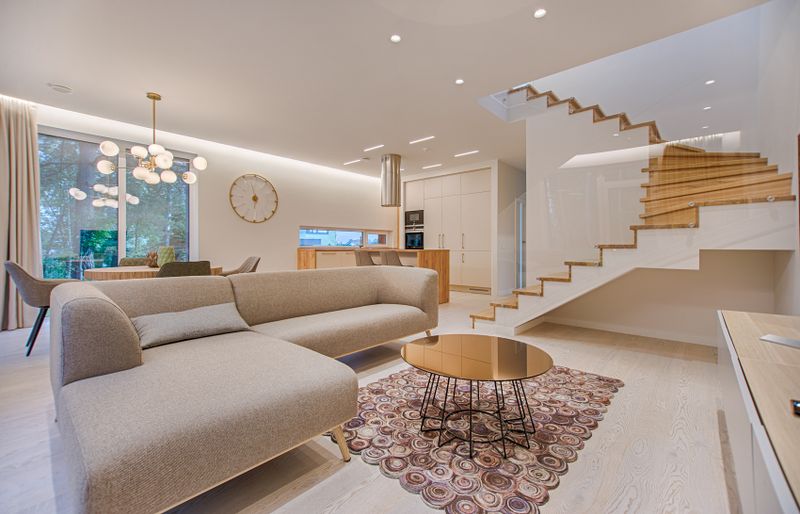
A budget approach to the feature wall — wallpaper in a quality vinyl specification or a painted textured finish — costs $500 to $1,500 and delivers a meaningful upgrade from plain white paint. A mid-range approach — fluted panel installation with integrated TV recess and concealed lighting — costs $2,500 to $5,000 and transforms the character of the room. A premium approach — full custom carpentry integrating storage, display niches, and architectural lighting — costs $6,000 to $12,000 but produces a result that photographs as well as a design magazine editorial.
Flooring: The Foundation of the Entire Aesthetic
Nothing ages a Singapore living room faster than old flooring. The shift from cold grey tiles to warm timber-effect vinyl planks or engineered parquet has been one of the defining flooring trends of the past three years and shows no sign of reversing. Vinyl plank flooring (SPC or LVT) is the practical choice for most HDB living rooms: moisture-resistant, dimensionally stable in Singapore’s humidity, hard-wearing, and available in convincing timber aesthetics from $5 to $12 per square foot supply and installation. Engineered parquet delivers a more premium result at $12 to $25 per square foot, with the warmth of genuine timber veneer backed by a dimensionally stable core that handles Singapore’s humidity better than solid timber.
Arched Doorways: The 2026 Architectural Detail
Arched doorway openings — converting square doorframes to arched profiles — have emerged as one of the most sought-after architectural details in Singapore renovations in 2025 and 2026. The arch introduces a sense of craftsmanship and visual softness that square frames cannot replicate, and it works with almost every design direction from Japandi to Mediterranean to contemporary. Converting an existing square doorway to an arched profile costs $800 to $2,000 per opening, depending on the construction method (MDF arched frame profile over existing opening, or full masonry arch requiring structural consideration). The visual impact is disproportionate to the cost.
Bedroom Renovation Ideas for Singapore HDB Flats
The Headboard Wall: Make the Bedroom Feel Intentional
In a standard HDB master bedroom of 11 to 14 square metres, the headboard wall is the primary design canvas. A simple but effective approach is to differentiate the headboard wall from the other three walls with a contrasting paint colour in a muted, sophisticated tone — deep sage, warm terracotta, or dusty blue — combined with simple concealed lighting above the bed. This costs $500 to $1,500 and transforms the room from a utilitarian space into one with genuine character.
A more architectural approach — incorporating a fluted or timber slat headboard panel, integrated bedside reading lights, and a concealed ledge for plants or objects — costs $2,500 to $5,000 for the carpentry and joinery work. This level of specification produces a bedroom that competes with boutique hotel interiors and significantly enhances the perceived quality of the space.
Storage: Built-In or Nothing
HDB bedrooms are small. The only way to manage storage in a space of 10 to 14 square metres without the room feeling cluttered is built-in carpentry. Floor-to-ceiling built-in wardrobes maximise every millimetre of vertical storage; a well-configured 3-metre wardrobe provides more usable storage than most freestanding alternatives while occupying less perceived floor space. Budget $5,500 to $9,000 for a mid-range laminate floor-to-ceiling wardrobe with sliding doors. Pair this with a built-in study desk or dressing table ($1,500 to $3,500) for a fully resolved bedroom that feels purposeful rather than improvised.
Secondary Bedrooms: Japandi for the Long Term
The Japandi aesthetic — a fusion of Japanese wabi-sabi sensibility with Scandinavian functional minimalism — is particularly well-suited to Singapore HDB secondary bedrooms. Its hallmarks are warm neutral tones, natural material textures (timber, linen, rattan), restrained ornamentation, and purposeful storage solutions. A Japandi secondary bedroom can be achieved with relatively modest investment: warm-toned SPC flooring ($5 to $8 per sqft), a built-in laminate wardrobe in a natural oak or ash tone ($5,000 to $7,000), and a limewash or textured paint finish on the headboard wall ($600 to $1,200). The result is a space that is restful, cohesive, and highly liveable.
Kitchen Renovation Ideas for Singapore HDB Flats
Open-Concept Kitchen: Maximum Impact, Requires Approval
Converting a closed HDB kitchen to a semi-open or fully open configuration — typically by removing or modifying the kitchen entrance wall — dramatically increases the perceived size of the combined living, dining, and kitchen area. This is one of the highest-impact spatial interventions available in a standard HDB flat and is particularly effective in 3-room and 4-room units where the default closed kitchen feels disproportionately compressed. Open-concept conversion requires HDB’s renovation permit for wall removal and must confirm that the wall is non-structural before any hacking commences. Total cost including wall removal, new kitchen fitout, and flooring continuation: $20,000 to $35,000.
Budget Kitchen Refresh: Maximum Efficiency
For homeowners who cannot justify a full kitchen renovation budget, a targeted refresh — replacing cabinet door fronts and hardware, installing a new countertop over existing base units, and retiling only the backsplash — can transform the appearance of a dated kitchen for $4,000 to $8,000. This is not a permanent solution and does not address waterproofing or the condition of underlying cabinet carcasses, but as a medium-term visual upgrade it delivers strong value per dollar spent.
Bathroom Renovation Ideas for Singapore HDB Flats
Material Pairings That Work in Singapore in 2026
The bathroom aesthetic in Singapore has moved toward warmer, softer material palettes — terrazzo-effect tiles, warm-toned neutrals, fluted ceramic feature tiles, and matte black or brushed gold hardware replacing the chrome and white gloss that dominated the previous decade. Terrazzo-effect floor tiles ($6 to $12 per sqft) paired with ribbed or fluted wall tiles ($8 to $18 per sqft) create a bathroom that feels considered and contemporary without the maintenance requirements of natural stone. Matte black tapware and accessories ($200 to $600 for a complete accessory set) add a finishing precision that elevates even a modest material specification.
The Wet/Dry Separation
Singapore HDB bathrooms are traditionally wet-room configurations where the shower area is not separated from the rest of the bathroom. Adding a frameless glass screen or a half-height glass panel to create a wet zone separation costs $600 to $1,500 and delivers a meaningful functional improvement — keeping the vanity and toilet area dry during showering — while also improving the visual quality of the space.
2026 Renovation Trends: Budget vs Premium
The clearest trend divergence in Singapore renovation in 2026 is between homeowners executing tightly scoped, high-craft budget renovations and those investing in full premium fitouts. At the budget end, the trend is toward focusing investment on the highest-visibility elements — feature wall, flooring, kitchen countertop, bathroom retiling — and keeping everything else restrained. At the premium end, the trend is toward whole-home architectural coherence: consistent material language across all rooms, built-in carpentry in every space, integrated lighting design, and contractor execution at a standard that reflects genuine skilled craftsmanship rather than commodity production.
Direct Contractor vs Interior Design Firm: What Matters for Renovation Ideas
Renovation platforms such as Qanvast and Livspace offer homeowners access to a curated pool of interior designers who can help translate renovation ideas into resolved design schemes. This service has genuine value for homeowners who lack design clarity or who want professional spatial planning support. The cost, however, is embedded in the renovation package: interior design firms typically price a full 4-room HDB renovation at $70,000 to $100,000+, compared to $50,000 to $75,000 for equivalent execution through a direct contractor.
Hock Star works with homeowners who arrive with a clear brief — or who want guidance from our project managers on material selection and space planning — without the design markup. Our approach is to translate your renovation ideas into a fully itemised, transparently priced scope of works executed by experienced tradespeople. The result is premium renovation quality at a cost structure that reflects direct contractor efficiency.
Disclaimer: References to third-party platforms and firms are provided for market context only. Pricing and service quality vary by project and individual provider.
Conclusion: Renovation Is an Investment — Treat It Like One
The best HDB renovation ideas in 2026 are not necessarily the most expensive or the most on-trend. They are the ones that are calibrated to your space, your lifestyle, and your budget — executed with quality materials and skilled workmanship that will look as good in year ten as they did on the day of completion. Plan thoroughly, scope clearly, and choose a contractor who delivers craftsmanship rather than speed.
Hock Star brings premium renovation execution to Singapore HDB and condo homeowners at direct contractor pricing. From full whole-home renovations to targeted room upgrades, every project is priced transparently and delivered to a premium specialist standard. Get your free renovation quote from Hock Star today.
Frequently Asked Questions
What are the best HDB renovation ideas in Singapore for 2026 that deliver the most visual impact?
The highest-impact renovation ideas for Singapore HDB flats in 2026 are: a fluted panel or timber slat feature wall for the living room ($2,500 to $5,000); warm-toned SPC or engineered parquet flooring across living and bedroom areas ($5 to $12 per sqft); a kitchen fitout with quality countertop and full-height cabinetry; and a complete bathroom retile with contemporary warm-neutral tiles. These four elements, done well, transform the character of a standard HDB flat more than any other equivalent investment.
What are the top interior design trends for Singapore HDB renovation in 2026?
The dominant design trends for Singapore HDB renovation in 2026 are: Japandi — the fusion of Japanese wabi-sabi and Scandinavian minimalism characterised by warm neutrals, natural textures, and purposeful storage; fluted panel feature walls in warm-toned laminates or timber veneer; timber slat screens and feature walls; arched doorway openings; warm-toned SPC and engineered parquet flooring; and terrazzo-effect tiling in bathrooms. The overarching direction is toward warmer, more material-rich interiors after years of white minimalism.
How much does a full HDB renovation cost in Singapore in 2026 for a 4-room flat?
A full renovation for a 4-room HDB flat in Singapore in 2026 covering all rooms — kitchen, both bathrooms, living and dining areas, and all bedrooms — typically costs $50,000 to $75,000 through a direct contractor at mid-range specifications. High-specification renovations with premium materials, custom carpentry throughout, and integrated lighting design reach $80,000 to $120,000. Engaging an interior design firm rather than a direct contractor typically adds 20 to 35 per cent to the total cost for equivalent trade execution.
What is the Japandi design style and how can I achieve it in my Singapore HDB flat?
Japandi is a design fusion of Japanese wabi-sabi — the appreciation of imperfection, natural materials, and restrained beauty — with Scandinavian functional minimalism. In a Singapore HDB context, Japandi is achieved through warm neutral paint tones (muted sage, warm white, dusty taupe), natural texture materials (timber slats, rattan, linen textiles), built-in carpentry in light oak or ash tones, warm-toned plank flooring, and purposeful storage that eliminates visual clutter. Japandi works particularly well in HDB flats because its emphasis on restraint and function suits the spatial constraints of the typology.
What HDB renovation ideas have the best return on investment for resale value in Singapore?
Kitchen and bathroom renovations consistently deliver the highest return on investment for HDB resale value in Singapore. A well-executed kitchen renovation ($15,000 to $25,000) and bathroom renovation ($7,000 to $15,000 per bathroom) significantly increase a flat’s market appeal and command price premiums at resale. Flooring replacement across the living area is also a high-ROI investment at modest cost ($5,000 to $10,000 for a 4-room living and dining area). Bespoke carpentry and elaborate feature walls, while visually impressive, typically return less of their cost at resale.