

Written by: Hock Star Direct Contractor Team (20+ Years HDB & BTO Experience) Last Updated: September 2026
Vinyl Flooring Singapore: Vinyl Flooring Singapore in Singapore — this guide covers everything you need to know for a successful outcome.
- Understanding vinyl flooring singapore helps avoid costly mistakes
- HDB and BCA regulations apply — always verify compliance
- Using a licensed contractor (Hock Star) ensures quality and accountability
The Bottom Line (BLUF)
If you are renovating an HDB flat or BTO in Singapore and want a waterproof, durable floor at the lowest possible cost and fastest timeline, vinyl flooring is almost always the right answer. Luxury Vinyl Tiles (LVT) cost between $3 to $15 per square foot depending on grade, install directly over existing tiles without hacking, and last 10 to 15 years in Singapore’s climate. The only decision left is which grade and which contractor.
- Budget LVT (0.3mm wear layer): $3 – $8 psf — suitable for low-traffic areas
- Mid-range LVT (0.5mm wear layer): $6 – $15 psf — recommended for all living areas
- Premium LVT (SPC core, 0.5mm+): $12 – $25 psf — best dimensional stability in Singapore’s humidity
- Typical 4-room HDB (850 sqft floor area): $4,500 – $12,000 installed
- No hacking permit required for LVT overlay on existing tiles
Prices updated September 2026. Ranges reflect direct contractor pricing; ID firm markups add 20–35%.
Most homeowners spend more than they need to on flooring simply because they don’t know that the overlay option exists. Understanding the HDB rules on overlay thickness — and working with a contractor who can source at factory price — changes the maths significantly.
Why Hock Star Recommends Luxury Vinyl Tiles (LVT)
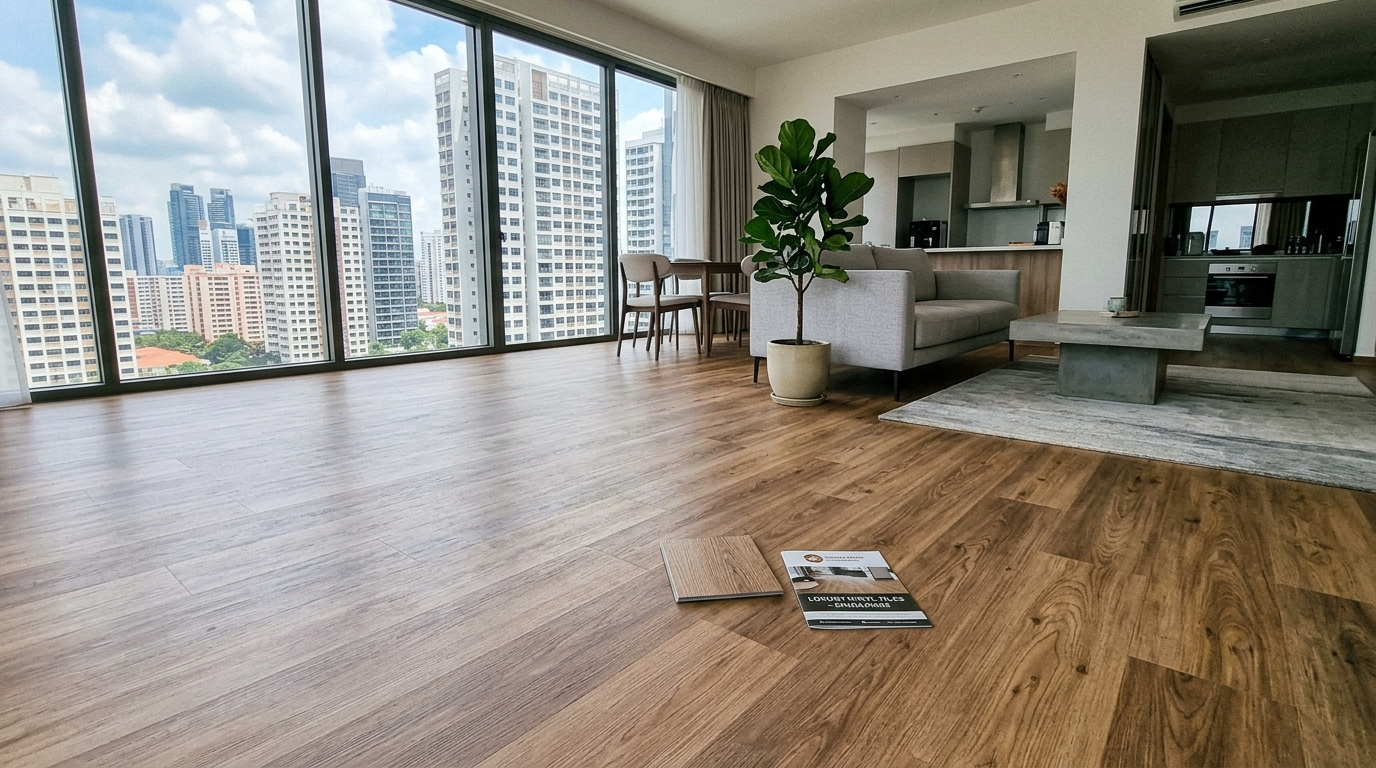
As direct contractors with over 500 completed HDB and condo renovations in Singapore, we recommend LVT to most homeowners before we recommend anything else. Unlike wood laminate — which warps in Singapore’s 80–85% average humidity — or ceramic tiles (which require expensive hacking and wet works), vinyl provides a seamless, premium aesthetic at a fraction of the cost and installation time. The overlay installation method means most homeowners are walking on new floors within two days of works commencing.
Vinyl vs. Laminate vs. Ceramic Tiles: 2026 Comparison
| Feature | Luxury Vinyl (LVT) | Wood Laminate | Ceramic Tiles |
|---|---|---|---|
|
Cost (PSF, 2026) |
$3 – $15 |
$3 – $8 |
$8 – $18+ |
|
Waterproof? |
Yes (100%) |
No — prone to warping |
Yes |
|
Installation |
1–2 days (overlay) |
1–2 days |
1–2 weeks (hacking req.) |
|
HDB Overlay? |
✅ Permitted |
✅ Permitted |
❌ Requires hacking |
|
Lifespan (SG climate) |
10–15 years |
5–10 years |
20+ years (grout stains) |
|
Maintenance |
Very easy |
Moderate — avoid wet mop |
Easy, grout darkens |
HDB Rules for Vinyl Flooring Overlay (2026)
Before beginning your renovation, you need to understand what the Housing & Development Board (HDB) permits and prohibits regarding flooring overlays. These rules apply whether you are in a BTO, resale flat, or executive apartment.
Overlay thickness limit: The total thickness of any new floor finish overlaid on existing HDB tiles must not exceed 50mm. This ensures doors can still open and close smoothly and does not affect the integrity of the structural slab. Most standard LVT products run 4–8mm thick and are well within this limit.
Skirting: When overlaying vinyl over existing tiles, the existing skirting typically needs to be overlaid or replaced with matching PVC skirting to cover the expansion gap and create a clean finish. Hock Star includes new PVC skirting in all vinyl flooring packages.
No hacking permit required: This is the single biggest advantage of vinyl overlay. Because no demolition works are required, you do not need an HDB hacking permit, which saves both paperwork time and 5–10 days on your renovation timeline. Hacking permit applications can take 7–14 working days to process — the vinyl overlay route bypasses this entirely.
Wet areas (bathrooms, kitchen): LVT can be installed in dry areas such as living rooms, bedrooms, and dining areas. For bathroom floors, ceramic tiles remain the HDB-preferred specification because of waterproofing requirements. Vinyl is not recommended for direct installation in wet areas unless it is specifically rated for wet applications.
The Hock Star Direct Contractor Advantage
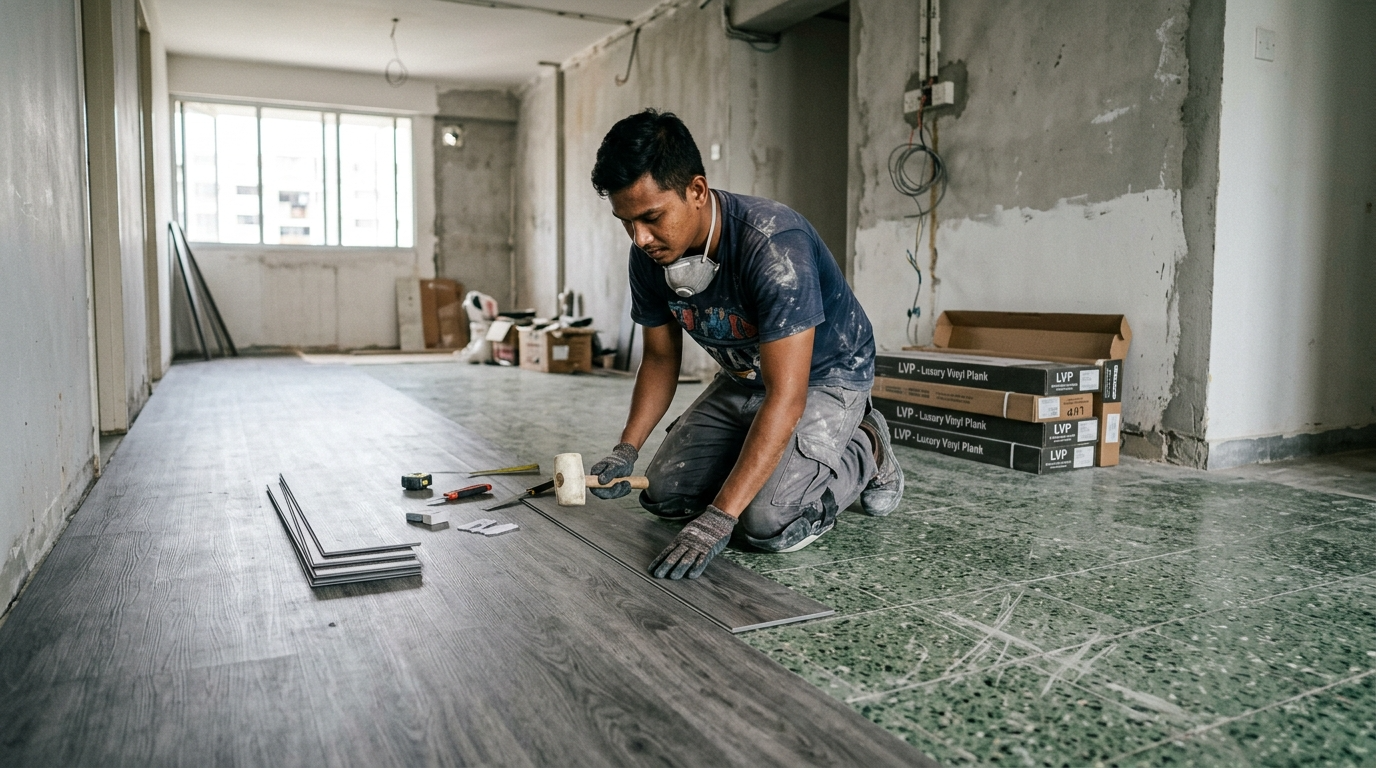
Interior Design firms typically outsource vinyl installation to a third-party flooring vendor and mark up the material cost by 20–30%. When you work with Hock Star Direct Contractor, you deal directly with the installation team. There is no ID firm in the middle, no referral fee, and no supply chain markup. You pay factory price for materials and direct labour rates — a saving that typically runs $1,500 to $3,000 on a standard 4-room HDB floor package compared to an ID firm quotation for the same specification.
How to Choose the Right Vinyl Grade for Your HDB
The most important specification in any LVT product is the wear layer thickness, measured in millimetres. This is the clear protective coating over the decorative layer and is what determines how long the floor will last under foot traffic. For residential use in Singapore, a 0.5mm (20 mil) wear layer is the practical minimum for all living areas. Entry points, corridors, and kitchen areas — which take the highest traffic — benefit from a 0.7mm or thicker wear layer.
Stone Plastic Composite (SPC) vinyl is a newer LVT format where the core is made from a rigid limestone composite rather than the flexible vinyl used in traditional LVT. SPC boards are dimensionally stiffer, less susceptible to indentation, and more resistant to the temperature cycling caused by air-conditioning. In Singapore’s climate, SPC is generally the superior long-term specification for main living areas, with traditional flexible LVT remaining a cost-effective option for bedrooms and lower-traffic areas. SPC products typically run $1.50–$4 per sqft more expensive than equivalent flexible LVT at the same wear layer specification.
What Does a 4-Room HDB Vinyl Flooring Installation Cost in 2026?
A standard 4-room HDB flat has approximately 850 to 950 square feet of floor area. Excluding bathrooms (where ceramic tile is typically retained), the vinyl flooring scope covers roughly 700 to 800 square feet of living room, dining area, bedrooms, and corridor. At mid-range LVT specification (0.5mm wear layer, $8–$12 psf all-in including supply, installation, and new PVC skirting), the total cost for a 4-room HDB vinyl overlay runs from $5,600 to $9,600. This is significantly lower than the equivalent ceramic tile replacement, which would require hacking (adding $3,000–$5,000) and an additional two weeks of renovation time.
Conclusion
Choosing vinyl flooring for your HDB renovation is not a compromise — at the right specification, it outperforms laminate in humidity resistance, installs without the mess and cost of hacking, and delivers a premium aesthetic finish that looks as good at year ten as it did on day one. The critical variables are wear layer thickness, SPC vs. flexible LVT core, and the quality of the installation — particularly the flatness of the substrate preparation and the precision of the joins at doorways.
Ready to start your flooring upgrade? Contact Hock Star Direct Contractor today for a transparent, 0% markup renovation quotation.
Frequently Asked Questions About Vinyl Flooring in Singapore (2026)
How much does vinyl flooring cost per square foot in Singapore in 2026?
Vinyl flooring in Singapore in 2026 costs between $3 and $25 per square foot (psf) depending on the grade and installation method. Budget LVT with a 0.3mm wear layer runs $3–$8 psf. Mid-range LVT with a 0.5mm wear layer — the recommended minimum for living areas — costs $6–$15 psf. Premium SPC vinyl with a rigid core and thick wear layer costs $12–$25 psf. These are direct contractor prices; add 20–35% for Interior Design firm pricing on the same product specification.
Can I install vinyl flooring over existing tiles in my HDB flat without hacking?
Yes. HDB permits vinyl flooring to be overlaid directly over existing floor tiles without a hacking permit, provided the total overlay thickness does not exceed 50mm. Most standard LVT products are 4–8mm thick, well within this limit. The overlay approach eliminates the cost of tile hacking ($3–$8 per sqft) and associated debris removal, saves 7–14 working days compared to a hack-and-retile approach, and avoids the noise and dust of demolition works. Skirting will need to be updated to accommodate the new floor height.
How long does vinyl flooring last in a Singapore HDB flat?
High-quality Luxury Vinyl Tiles (LVT) with a 0.5mm commercial-grade wear layer will last 10 to 15 years in a Singapore residential home with normal maintenance. SPC (Stone Plastic Composite) vinyl, which has a rigid core, can last longer as it is more resistant to indentation and temperature cycling from air-conditioning. Budget vinyl with a 0.3mm wear layer typically lasts 5 to 8 years before showing significant wear in high-traffic areas. Choosing the right wear layer thickness for your traffic level is the single most important decision in vinyl flooring selection.
Is vinyl flooring waterproof and suitable for Singapore’s humidity?
Luxury Vinyl Tiles (LVT) are 100% waterproof — the material itself does not absorb water. This makes it significantly more suitable for Singapore’s average 82% relative humidity than wood laminate, which warps and delaminates in humid conditions. LVT is safe to damp-mop and handles spills and condensation without damage. For bathroom wet areas, ceramic tile remains the preferred specification as the substrate waterproofing requirements differ. For all dry areas — living rooms, bedrooms, dining rooms, corridors — LVT is the most humidity-resistant flooring option at any comparable price point.
What is the difference between LVT and SPC vinyl flooring in Singapore?
LVT (Luxury Vinyl Tile) refers to flexible vinyl flooring with a layered construction — wear layer, decorative layer, and flexible core. SPC (Stone Plastic Composite) is a newer format where the core is made from a rigid limestone and PVC composite, making it dimensionally stiffer and more resistant to indentation and temperature changes. In Singapore’s climate, SPC is the superior specification for main living areas because air-conditioning creates temperature differentials that can cause flexible LVT to expand and contract, sometimes causing edge lifting over time. SPC costs $1.50–$4 more per sqft than equivalent flexible LVT. For bedrooms and lower-traffic areas, standard LVT remains a cost-effective and durable choice.
Which is better for an HDB flat in Singapore — vinyl flooring or wood laminate?
For most Singapore HDB flats, vinyl flooring outperforms wood laminate on the most important practical criteria. Vinyl is 100% waterproof; laminate is not and will warp at joints and edges in Singapore’s humidity, especially in rooms that are not consistently air-conditioned. Both materials can be overlaid without hacking. Vinyl is easier to clean, softer underfoot, and more resistant to scratching in daily use. Laminate has a slightly more convincing wood-plank visual depth, which matters to some homeowners. At equivalent quality grades, pricing is broadly similar — the performance advantage clearly favours vinyl for Singapore’s climate conditions.
Disclaimer: The information provided in this article is for general informational purposes only. Renovation costs, material prices, and HDB flooring guidelines are subject to change. Always consult a licensed direct contractor for an accurate on-site assessment before starting your renovation.
For official HDB renovation guidelines and approved contractor requirements, visit the HDB renovation portal. Contractor licensing is governed by the Building and Construction Authority (BCA).