

Built-In Wardrobe Singapore: The Complete 2026 Guide (Cost, Designs & HDB Rules)

Built-in wardrobes are one of the most requested carpentry items in Singapore renovations — and one of the most misunderstood in terms of cost, materials, and what HDB will and will not permit. In a country where bedrooms routinely measure 9 to 12 square metres, a well-designed built-in wardrobe is not a luxury; it is a spatial necessity. Get the specification right, and it serves you for twenty years. Get it wrong, and you are looking at a costly replacement within five. Quick Answer: Built-In Wardrobe Singapore 2026 Built-in wardrobe cost (standard laminate): $1,800 – $3,500 per linear metre Sliding door systems: $400 – $900 per panel additional cost Full floor-to-ceiling 3-metre wardrobe (mid-range): $5,000 – $9,000 Walk-in wardrobe fitout: $8,000 – $20,000+ depending on size and specification HDB rules: No permit required for non-structural built-in wardrobes in bedrooms The choice between built-in and freestanding, sliding and hinged, laminate and solid wood involves genuine trade-offs — not just aesthetic preferences. Each decision has direct implications for cost, longevity, and suitability for Singapore’s climate. This guide lays out the full picture so you can make an informed decision before you commit to a specification. Built-In vs Freestanding Wardrobes: Making the Right Choice for Singapore Homes Freestanding wardrobes — whether flat-pack systems like IKEA PAX or solid timber pieces — offer one significant advantage over built-ins: they move with you. For homeowners in rented accommodation or those who anticipate relocating within five years, freestanding makes financial sense. For HDB and condo owners planning to stay for the medium to long term, built-in wardrobes consistently deliver better value. A built-in wardrobe is designed and fabricated to the exact dimensions of your bedroom wall, maximising every millimetre of usable storage space. It is integrated with the room’s architectural language — flush with the ceiling if designed floor-to-ceiling, aligned with doorframes, and finished with materials that match your other carpentry pieces. This level of integration is structurally and aesthetically impossible to achieve with freestanding furniture. In Singapore’s humid climate (average relative humidity of 82%), built-in wardrobes also have the advantage of being constructed from moisture-resistant boards rather than the solid timber or particleboard used in most imported freestanding furniture. Built-In Wardrobe Materials: Laminate vs Melamine vs Solid Wood Melamine Board Melamine is the entry-level substrate used in most Singapore built-in wardrobes. It consists of a particleboard or MDF core coated with a melamine resin surface paper, available in a wide range of colours and wood-effect finishes. Melamine is cost-effective, reasonably durable, and serviceable for most residential applications. Its primary limitation in Singapore’s climate is susceptibility to moisture damage if seals are compromised — a risk that is managed through proper construction techniques (sealed edges, appropriate joinery) rather than material substitution. A full floor-to-ceiling wardrobe in standard melamine for a 3-metre wall costs approximately $4,000 to $7,000 installed. Laminate Board Laminate wardrobes use a high-pressure laminate (HPL) surface applied to a particleboard or moisture-resistant (MR) board substrate. HPL is significantly more durable and scratch-resistant than melamine, with better resistance to moisture penetration. The surface options for laminate are extensive — matte, gloss, textured, wood-grain, and stone-effect finishes are all available. A floor-to-ceiling wardrobe in mid-range laminate for a 3-metre wall costs approximately $5,500 to $9,000 installed. For most Singapore homeowners, laminate on MR board represents the optimal balance of cost, durability, and aesthetics. Solid Wood and Timber Veneer Solid timber wardrobes are rare in Singapore renovation contexts because solid wood responds to humidity changes by expanding and contracting — a characteristic that leads to warping, cracking, and door misalignment in Singapore’s climate over time. Timber veneer on MR board is a more practical approach, delivering the visual warmth of natural timber with the dimensional stability of an engineered substrate. Timber veneer wardrobes cost $2,500 to $4,500 per linear metre installed, making them a premium specification suited to high-end renovations. Sliding vs Hinged Doors: Which Is Better for Singapore HDB Flats? The sliding versus hinged decision is primarily a function of space. Hinged doors require clearance in front of the wardrobe equal to the door width — typically 450 to 600mm — to open fully. In a standard HDB bedroom of 9 to 12 square metres, this clearance can represent a meaningful portion of usable floor space, particularly in rooms with beds positioned close to the wardrobe wall. Sliding doors eliminate the swing clearance requirement and tend to deliver a cleaner, more contemporary aesthetic. They are, however, more expensive to install ($400 to $900 per panel for a quality aluminium-framed system) and more complex to maintain — the track and roller systems require periodic adjustment and cleaning. For bedrooms smaller than 10 square metres, sliding doors are almost always the pragmatic choice. For larger rooms, hinged doors offer better access to the full wardrobe interior and simpler mechanics over the long term. Built-In Wardrobe Internal Configuration: Getting the Layout Right The internal layout of your wardrobe — hanging rails, shelving, drawers, pull-out accessories — determines how effectively you use the space. A common mistake is over-specifying hanging space at the expense of shelving. In Singapore’s climate, folded clothing on shelves actually fares better than hanging garments in humid conditions, as airflow between folded items is more consistent. A balanced configuration for a standard 3-metre wardrobe might include one to two hanging bays (each 600 to 700mm wide), four to six shelves, and two to three drawers at the base. Pull-out accessories — tie racks, belt hooks, jewellery trays, shoe racks — add $200 to $600 each and are worth specifying selectively rather than comprehensively. Over-accessorised wardrobes often end up underutilised because the accessories add complexity without proportional functional benefit. HDB Rules for Built-In Wardrobes Built-in wardrobes installed within bedrooms — meaning they are constructed against existing walls without any structural modification — do not require an HDB renovation permit. This makes bedroom wardrobes one of the few renovation items that can proceed immediately after key collection without waiting for permit approval. The key condition is that
Bathroom Renovation Cost Singapore: The 2026 Complete Guide for HDB & Condo Homeowners

Bathroom renovation is among the most technically complex and cost-intensive scopes in any Singapore home renovation. It involves wet works, waterproofing, plumbing, electrical (for lighting, exhaust, and in some cases water heaters), and tiling — all compressed into a space that is, in a standard HDB flat, typically 4 to 7 square metres. Cost overruns in bathroom renovations are common, and they are almost always attributable to one of two causes: incomplete scope definition at quotation stage, or failure to address underlying waterproofing issues before tiling commences. Quick Answer: Bathroom Renovation Cost Singapore 2026 Cosmetic refresh (fixtures only, no hacking): $2,500 – $5,000 Mid-range renovation (full hack, tile, new fixtures): $7,000 – $12,000 Premium full renovation (high-end tiles, fittings, rain shower): $14,000 – $25,000 HDB master bathroom (larger, full renovation): $9,000 – $16,000 HDB requires waterproofing to a minimum 1,800mm height on shower walls Bathroom renovations reward homeowners who understand the scope before committing. The difference between a cosmetic refresh and a full gut renovation is not merely cosmetic — it reflects fundamentally different approaches to the longevity of the space. This guide walks through cost by scope, component-level pricing, the wet/dry works distinction, HDB’s waterproofing requirements, and what to demand from any contractor before signing. Bathroom Renovation by Scope: Understanding the Spectrum Cosmetic Refresh (No Hacking) A cosmetic bathroom refresh involves replacing fixtures and fittings — toilet bowl, basin, tap, shower head, accessories — without any hacking of existing tiles. This scope is appropriate only when existing tiles are in sound condition with no cracking, hollow spots, or active leaks. A full fixture replacement with no hacking costs $2,500 to $5,000 for a standard HDB common bathroom, inclusive of labour and supply of mid-range fittings. This scope offers the lowest disruption and shortest timeline (typically 3 to 5 days) but provides no improvement to waterproofing integrity. Partial Renovation (Floor Only or Feature Tile Replacement) Some homeowners opt for partial renovations — for example, hacking and replacing only the floor tiles while retaining existing wall tiles, or replacing the shower wall tiles while leaving the floor intact. This approach is cost-effective in theory but carries a risk: partial hacking can disturb adjacent tile bonding, leading to hollow areas that subsequently crack or leak. If the existing tiles show any signs of hollowness (identifiable by tapping), a full hack is almost always more economical in the long run. A partial renovation costs $4,000 to $7,500 depending on scope. Full Renovation (Complete Hack and Fitout) A full bathroom renovation involves complete hacking of all existing floor and wall tiles, full application of new waterproofing membrane, new tiling throughout, replacement of all fixtures, and upgrade of lighting and electrical points where required. This is the only scope that provides a genuine reset of the bathroom’s waterproofing system — and in Singapore’s context, where leakage between floors is a common dispute between neighbours, proper waterproofing is not optional. A full mid-range renovation for a standard HDB common bathroom (4 to 5 sqm) costs $7,000 to $12,000. A full renovation for a master bathroom (5 to 7 sqm) costs $9,000 to $16,000 depending on specifications. Bathroom Renovation Cost by Component Hacking Works Full hacking of floor and wall tiles in a standard HDB bathroom costs $1,200 to $2,500, depending on the number of existing tile layers and site access. Bathrooms with multiple layers of overlay tiles — common in older resale flats — cost more to hack and may require additional debris removal and surface preparation. Hacking generates significant noise and dust, and HDB restricts hacking to Monday to Saturday between 9:00am and 5:00pm (with a midday break on certain days in some HDB blocks). Waterproofing Waterproofing is the most critical and most frequently cut-cornered item in Singapore bathroom renovations. HDB requires waterproofing to a minimum height of 1,800mm on shower walls; reputable contractors apply membrane to the full height of wet area walls as best practice. Two-component cementitious waterproofing membrane — the standard commercial specification — costs $800 to $1,800 for a standard HDB bathroom. This is not a line item to economise on: a failed waterproofing membrane leads to leakage through the floor slab, potential structural damage, and disputes with the downstairs neighbour that can cost tens of thousands of dollars to resolve. Tiling (Supply and Installation) Tile supply and installation for a complete HDB bathroom (floor and walls) costs $2,500 to $5,500, depending on tile size, format, and the complexity of the layout. Large-format tiles (600x600mm and above) in bathrooms require a higher standard of substrate preparation and are more expensive to lay due to levelling requirements. Mosaic or feature tiles, particularly for a dedicated shower feature wall, add $500 to $1,500 to the tiling budget. The tile specification itself — from a $2/sqft standard ceramic to a $15+/sqft premium porcelain — drives a significant portion of the variance in overall bathroom cost. Sanitary Fixtures (Toilet Bowl, Basin, Shower) Mid-range sanitary fixtures for a complete bathroom — wall-hung or floor-mounted toilet bowl, vanity with basin, shower mixer, fixed rain shower or shower column — cost $2,000 to $4,500 for supply and installation. Upgrading to a wall-hung toilet with concealed cistern adds $600 to $1,200 for the in-wall cistern frame. Premium European brands (Grohe, Hansgrohe, Roca, Duravit) double or triple the fixture cost but deliver meaningfully better performance and aesthetics over a twenty-year service life. Shower Screen or Bath Enclosure A standard frameless or semi-frameless tempered glass shower screen costs $600 to $1,500 installed. Full glass shower enclosures (three-sided) cost $1,200 to $2,500. Frameless glass with minimal hardware commands a premium but delivers a cleaner aesthetic and is easier to clean in Singapore’s hard water conditions. Electrical Works Bathroom electrical works typically cover lighting replacement (concealed LED cove or surface-mounted), exhaust fan replacement, and storage water heater replacement if applicable. A comprehensive electrical package for a bathroom runs $600 to $1,500 depending on scope. Instant water heaters are generally preferred in Singapore over storage heaters for their space efficiency and consistent performance;
Partition Board Singapore: Types, HDB Rules & Costs (2026 Guide)

Partition boards are one of the most flexible and practical tools available to Singapore homeowners looking to reconfigure their living space without major structural works. Whether you are dividing an open-plan living area to create a home office, separating a study nook in a bedroom, or adding a feature divider between living and dining zones, the right partition system can transform the functionality of your HDB or condo unit at a fraction of the cost of structural modification. Quick Answer: Partition Board Singapore 2026 Gypsum board partition: $80 – $150 per sqm installed Glass partition (framed): $200 – $450 per sqm installed Timber/timber-effect partition: $150 – $350 per sqm installed Non-structural partitions in HDB: No permit required in most cases Full partition wall (floor-to-ceiling, 3m x 2.6m): $600 – $3,000+ depending on material The partition market in Singapore has expanded considerably as homeowners adapt their living spaces to post-pandemic work-from-home requirements. The choice of partition system — gypsum, glass, timber, or a hybrid — involves trade-offs in cost, acoustic performance, light transmission, and HDB compliance. This guide breaks down each option clearly. Types of Partition Boards in Singapore Gypsum Board (Drywall) Partitions Gypsum board — commonly referred to as drywall or plasterboard — is the most widely used partition material in Singapore residential and commercial renovations. It consists of a gypsum plaster core sandwiched between two sheets of paper facing, fabricated into boards typically 12mm or 15mm thick. Gypsum board partitions are constructed on a metal stud frame (typically galvanised steel studs at 400mm or 600mm centres), with boards fixed to both faces of the frame, joints taped and plastered, and the finished surface skim-coated and painted. The primary advantages of gypsum board partitions are cost, constructability, and versatility. They can be built to any configuration, incorporate doors and windows, receive any paint finish, and integrate electrical conduits and data cabling within the cavity. The primary limitation is acoustic performance: a standard single-layer gypsum partition provides only modest sound reduction (approximately 35 to 40 dB STC). For home offices or study rooms requiring meaningful acoustic separation, double-layer gypsum with acoustic insulation within the cavity is recommended — this upgrades sound reduction to 45 to 55 dB STC and adds $30 to $50 per sqm to the base cost. Installed cost for a standard single-layer gypsum board partition in Singapore runs $80 to $130 per sqm, inclusive of metal stud frame, boards, taping, plastering, and a single coat of paint. Double-layer acoustic partitions cost $130 to $200 per sqm. Glass Partitions Glass partitions are popular in Singapore homes for their ability to separate spaces while preserving light transmission and visual connectivity. They are most commonly specified for home offices (maintaining visual supervision of children while working), study rooms, and living/dining separators in open-plan layouts. The key specification choices are framed versus frameless systems, clear versus frosted or tinted glass, and fixed versus operable (sliding or pivot) panels. Framed glass partitions — using aluminium or steel profiles to hold tempered glass panels — cost $200 to $300 per sqm installed. Frameless glass partitions, which use structural silicone joints or minimal hardware fittings, cost $300 to $450 per sqm and deliver a cleaner aesthetic. All glass partitions in Singapore should use tempered (safety) glass of at least 10mm thickness; thinner glass is not appropriate for floor-to-ceiling residential applications. Frosted or sandblasted finishes add $20 to $50 per sqm to the glass cost. Timber and Timber-Effect Partitions Timber partitions — whether constructed from solid timber battens, engineered timber panels, or timber-effect laminate on a lightweight frame — offer warmth and texture that gypsum and glass cannot replicate. They are particularly popular as living room feature dividers, where the visual quality of the material is as important as the functional separation it provides. Slatted timber screens (vertical or horizontal battens with gaps) are a current design trend in Singapore, providing partial visual separation while maintaining airflow — a meaningful benefit in Singapore’s climate. Solid timber partitions cost $250 to $450 per sqm installed. Engineered timber or timber-effect laminate partitions cost $150 to $300 per sqm. Slatted screen partitions (half-height or full-height) cost $180 to $350 per sqm depending on batten material, profile, and spacing. For Singapore’s humidity environment, ensure timber components are treated or sealed and that the species or board product selected is rated for high-humidity applications. HDB Partition Rules: What Requires a Permit and What Does Not This is the question most homeowners have when considering a partition installation, and the answer depends on whether the partition is structural or non-structural. Non-structural partitions — lightweight partitions that divide space without carrying any load from floors or beams above — generally do not require an HDB renovation permit. This covers the vast majority of gypsum, glass, and timber partitions installed in HDB flats. Non-structural partitions can be installed, moved, and removed without affecting the structural integrity of the building. The requirement for a permit arises when the proposed partition involves or abuts structural elements. If you are constructing a partition that will be fixed to an existing structural wall or beam, or if the partition design involves any hacking into the floor slab for floor channel fixings (as is the case with some frameless glass systems), a renovation permit is required. Similarly, if the partition installation involves electrical works — adding new power points, lighting circuits, or data outlets within the partition — an electrical renovation permit is required. HDB rules also prohibit the construction of partitions that obstruct means of escape or create habitable rooms without adequate natural light and ventilation. A room created by partitioning must not be entirely enclosed without a means of ventilation to the outside. This is a practical constraint that affects some home office configurations — discuss your proposed layout with your contractor before finalising the design. How to Select the Right Partition System for Your Singapore Home The decision framework for partition selection in Singapore should weigh four factors: the functional purpose of the partition, the
Feature Wall Singapore: Ideas, Costs & The Best Materials for HDB Homes

The feature wall has become the defining element of Singapore interior design in the 2020s. In a country where living rooms average 25 to 35 square metres and the TV wall is the primary focal point, the decision about what to put on that wall — and how to execute it — carries more visual weight than almost any other renovation decision. Done well, a feature wall transforms a functional space into one with genuine character. Done poorly, it becomes an expensive mistake that is expensive to reverse. Quick Answer: Feature Wall Singapore 2026 Fluted panel feature wall: $1,500 – $4,500 for a standard 3–4 metre TV wall Brick-effect tile feature wall: $1,200 – $2,800 Timber slat feature wall: $1,800 – $4,000 Wallpaper feature wall: $400 – $1,500 Stone veneer or stacked stone: $2,500 – $6,000+ Understanding which feature wall material performs best in Singapore’s climate — where average relative humidity runs at 82 per cent and air-conditioning cycles create significant temperature differentials — matters as much as the design aesthetic. Some materials that look spectacular in European interiors underperform in Singapore’s conditions. This guide covers what works, what costs, and what lasts. The Most Popular Feature Wall Types in Singapore in 2026 Fluted Panel Feature Walls Fluted panels — vertical-ribbed profiles in laminate, timber veneer, or PVC — have been the dominant feature wall trend in Singapore since 2022 and show no sign of losing momentum in 2026. Their appeal is architectural: the vertical rhythm of the fluting draws the eye upward, adding apparent height to rooms in HDB flats where ceiling heights are typically 2.6 metres. They also provide a sophisticated textural quality that flat surfaces cannot replicate. Fluted panels are available in several substrate options. Laminate-faced fluted panels are the most common — they combine the durability of high-pressure laminate with a three-dimensional profile and are available in a wide range of colours, from muted natural tones to deep jewel colours. Timber veneer fluted panels deliver a more premium aesthetic with natural grain variation but require sealing for Singapore’s humidity. PVC fluted panels are the most moisture-resistant option and the most affordable, but the surface texture is less convincing at close range than laminate or veneer alternatives. A standard 3 to 4 metre fluted panel TV feature wall — covering the full height of the wall from floor to ceiling — costs $1,500 to $4,500 installed, depending on panel material, the complexity of the TV recess or carpentry integration, and whether concealed LED backlighting is included. Backlit fluted panel walls add $400 to $800 for the LED strip and diffuser profile installation. Brick-Effect Tile Feature Walls Brick-effect tiles — whether ceramic, porcelain, or genuine handmade clay brick slips — have maintained strong demand in Singapore because of their ability to add visual warmth and tactile texture to any room. They work particularly well in dining areas, bedroom headboard walls, and study alcoves. The industrial aesthetic of exposed brick reads equally well in contemporary and Japandi-influenced interiors. For Singapore’s climate, porcelain brick-effect tiles are preferred over genuine clay brick slips. Genuine clay is porous and absorbs moisture, which in Singapore’s humidity creates conditions for mould growth and surface efflorescence. Porcelain brick-effect tiles (ranging from $3 to $12 per sqft) replicate the texture and variation of handmade brick while remaining impermeable and easy to maintain. A standard feature wall in brick-effect porcelain (approximately 10 to 15 sqm) costs $1,200 to $2,800 installed, inclusive of tile supply, adhesive, grouting, and labour. Timber Slat Feature Walls Timber slat walls — horizontal or vertical battens of timber or timber-composite material, typically fixed to a backing board or directly to the wall — have emerged as one of the defining aesthetics of Japandi-influenced Singapore interiors. The appeal is biophilic: natural material texture in a space dominated by concrete and paint introduces a sensory dimension that transforms the quality of the room. Timber slat walls are equally effective as TV walls, bedroom headboard walls, or dining area backdrops. The material specification matters enormously in Singapore’s climate. Solid timber slat walls — using species such as American Walnut, White Oak, or Teak — are visually beautiful but require regular maintenance (oiling or sealing) in Singapore’s humidity and are susceptible to warping if improperly acclimated before installation. Timber-composite slat panels — using a recycled wood-fibre and polymer core with a genuine timber veneer surface — offer better dimensional stability in humid conditions at 60 to 80 per cent of the cost of solid timber alternatives. A full timber slat TV wall (3 to 4 metres wide, floor-to-ceiling) costs $1,800 to $4,000 installed. Wallpaper Feature Walls Wallpaper remains a cost-effective way to introduce pattern, colour, and texture to a feature wall in Singapore. The product range has expanded considerably — premium textured wallpapers, grasscloth, fabric-backed vinyls, and digital-print murals are all available through Singapore distributors. The primary consideration in Singapore’s context is moisture resistance: paper-backed wallpapers are unsuitable for Singapore’s humidity levels and will peel, bubble, or develop mould within two to three years. Vinyl-backed or non-woven wallpapers are the appropriate specification for all Singapore applications. Wallpaper supply and installation for a standard feature wall (approximately 10 to 15 sqm) costs $400 to $1,500 depending on the wallpaper specification and the wall preparation required. Premium designer wallpapers from brands such as Elitis, Pierre Frey, or Graham & Brown cost significantly more at the supply end ($30 to $150+ per sqm for the wallcovering alone) but can deliver a level of visual sophistication that tile or panel alternatives cannot match. Stone Veneer and Stacked Stone Feature Walls Stone veneer panels and stacked stone feature walls deliver maximum visual impact but carry the highest cost and the most significant maintenance considerations. Natural stone — whether marble, travertine, slate, or quartzite — applied to an interior feature wall creates an undeniably luxurious result. The practical concerns for Singapore are weight (natural stone adds significant load to wall fixings), porosity (unsealed natural stone absorbs moisture and stains in humid conditions),
Top Renovation Ideas for Singapore HDB Flats in 2026

HDB renovation in 2026 sits at the intersection of two powerful forces: a resale market that has driven prices up 9.7 per cent year-on-year, making renovation investment increasingly worthwhile, and a design landscape that has shifted decisively toward warmer, more material-rich aesthetics after years of white minimalism. Whether you are renovating a freshly collected BTO, refreshing a mid-cycle resale flat, or undertaking a full overhaul of an older unit, the ideas in this guide are grounded in what actually works in Singapore homes — spatially, climatically, and practically. Quick Answer: HDB Renovation Ideas Singapore 2026 Top 2026 design trends: Japandi, fluted panels, arched doorways, biophilic elements, warm neutrals Most impactful budget renovation: Feature wall + flooring refresh (from $5,000) Most impactful whole-home renovation: Full kitchen + bathrooms + living area carpentry ($50,000–$80,000 for a 4-room) Highest ROI renovation for resale HDB: Kitchen and bathroom upgrades Key rule: Good renovation rewards constraint and clarity — know your brief before you begin The most common renovation mistake in Singapore is not over-spending — it is under-planning. Homeowners who enter a renovation without a clear spatial brief, a defined aesthetic direction, and an honest budget assessment consistently encounter scope creep, mid-project design changes, and the kind of cost overruns that turn a renovation into a financial stress event. The ideas in this guide are organised by room, with both budget and premium execution options so you can calibrate to your actual position. Living Room Renovation Ideas for Singapore HDB Flats in 2026 The Feature Wall: Still the Most Impactful Single Element The TV wall remains the defining focal point of the Singapore HDB living room, and in 2026 the design language for that wall has evolved considerably from the lacquered cabinet-and-open-shelf configurations that dominated the 2010s. The current vocabulary is textural and warm: fluted panels in natural or warm-toned laminates, timber slat screens, or a combination of both, often with integrated indirect LED lighting that layers the ambience of the space beyond what direct overhead lighting achieves. A budget approach to the feature wall — wallpaper in a quality vinyl specification or a painted textured finish — costs $500 to $1,500 and delivers a meaningful upgrade from plain white paint. A mid-range approach — fluted panel installation with integrated TV recess and concealed lighting — costs $2,500 to $5,000 and transforms the character of the room. A premium approach — full custom carpentry integrating storage, display niches, and architectural lighting — costs $6,000 to $12,000 but produces a result that photographs as well as a design magazine editorial. Flooring: The Foundation of the Entire Aesthetic Nothing ages a Singapore living room faster than old flooring. The shift from cold grey tiles to warm timber-effect vinyl planks or engineered parquet has been one of the defining flooring trends of the past three years and shows no sign of reversing. Vinyl plank flooring (SPC or LVT) is the practical choice for most HDB living rooms: moisture-resistant, dimensionally stable in Singapore’s humidity, hard-wearing, and available in convincing timber aesthetics from $5 to $12 per square foot supply and installation. Engineered parquet delivers a more premium result at $12 to $25 per square foot, with the warmth of genuine timber veneer backed by a dimensionally stable core that handles Singapore’s humidity better than solid timber. Arched Doorways: The 2026 Architectural Detail Arched doorway openings — converting square doorframes to arched profiles — have emerged as one of the most sought-after architectural details in Singapore renovations in 2025 and 2026. The arch introduces a sense of craftsmanship and visual softness that square frames cannot replicate, and it works with almost every design direction from Japandi to Mediterranean to contemporary. Converting an existing square doorway to an arched profile costs $800 to $2,000 per opening, depending on the construction method (MDF arched frame profile over existing opening, or full masonry arch requiring structural consideration). The visual impact is disproportionate to the cost. Bedroom Renovation Ideas for Singapore HDB Flats The Headboard Wall: Make the Bedroom Feel Intentional In a standard HDB master bedroom of 11 to 14 square metres, the headboard wall is the primary design canvas. A simple but effective approach is to differentiate the headboard wall from the other three walls with a contrasting paint colour in a muted, sophisticated tone — deep sage, warm terracotta, or dusty blue — combined with simple concealed lighting above the bed. This costs $500 to $1,500 and transforms the room from a utilitarian space into one with genuine character. A more architectural approach — incorporating a fluted or timber slat headboard panel, integrated bedside reading lights, and a concealed ledge for plants or objects — costs $2,500 to $5,000 for the carpentry and joinery work. This level of specification produces a bedroom that competes with boutique hotel interiors and significantly enhances the perceived quality of the space. Storage: Built-In or Nothing HDB bedrooms are small. The only way to manage storage in a space of 10 to 14 square metres without the room feeling cluttered is built-in carpentry. Floor-to-ceiling built-in wardrobes maximise every millimetre of vertical storage; a well-configured 3-metre wardrobe provides more usable storage than most freestanding alternatives while occupying less perceived floor space. Budget $5,500 to $9,000 for a mid-range laminate floor-to-ceiling wardrobe with sliding doors. Pair this with a built-in study desk or dressing table ($1,500 to $3,500) for a fully resolved bedroom that feels purposeful rather than improvised. Secondary Bedrooms: Japandi for the Long Term The Japandi aesthetic — a fusion of Japanese wabi-sabi sensibility with Scandinavian functional minimalism — is particularly well-suited to Singapore HDB secondary bedrooms. Its hallmarks are warm neutral tones, natural material textures (timber, linen, rattan), restrained ornamentation, and purposeful storage solutions. A Japandi secondary bedroom can be achieved with relatively modest investment: warm-toned SPC flooring ($5 to $8 per sqft), a built-in laminate wardrobe in a natural oak or ash tone ($5,000 to $7,000), and a limewash or textured paint finish on the headboard wall ($600 to $1,200). The result
Parquet Flooring Singapore: The Complete Guide to Costs, Types & Installation (2025–2026)

Parquet flooring has experienced a significant resurgence in Singapore renovation projects over the past three years. After a decade in which vinyl plank and large-format porcelain tiles dominated the market, parquet — and particularly the herringbone layout that has become synonymous with contemporary high-end interiors — has returned as the premium flooring specification of choice for Singapore homeowners who want warmth, character, and longevity underfoot. Understanding the full spectrum of what parquet means in Singapore in 2026 — the types, costs, and performance implications in a climate with 82 per cent average humidity — is essential before you commit to a specification. Quick Answer: Parquet Flooring Singapore 2026 Solid parquet flooring: $10 – $25 per sqft supply and installation Engineered parquet flooring: $8 – $20 per sqft supply and installation Herringbone layout premium: 15–25% over straight-lay installation cost Singapore humidity concern: Engineered parquet is significantly more stable than solid parquet in Singapore’s 82% average humidity HDB rule: Flooring must achieve minimum Impact Isolation Class (IIC) 50 and Sound Transmission Class (STC) 50 for upper-floor units The choice between solid and engineered parquet is not simply about budget — it is about understanding how timber behaves in Singapore’s climate, and which product will still look as it should after five, ten, and fifteen years of humidity cycling. This guide covers everything: types and costs, the herringbone trend, how parquet compares to vinyl and laminate alternatives, and the HDB rules that govern flooring installations in the country’s most common housing typology. Solid vs Engineered Parquet: The Critical Distinction for Singapore Solid Parquet Flooring Solid parquet consists of individual timber fingers or strips manufactured entirely from a single species of timber — typically Merbau, Chengal, American Walnut, White Oak, or Teak — cut to a consistent profile and dimension. The defining characteristic of solid timber is that it moves: timber is hygroscopic, meaning it absorbs and releases moisture in response to changes in ambient humidity. In Singapore’s climate, where relative humidity fluctuates between 65 and 95 per cent and air-conditioning creates a 10 to 15 degree temperature differential indoors, solid parquet undergoes significant dimensional cycling. This movement is not necessarily a defect — well-installed solid parquet with appropriate expansion gaps manages the movement without distress. However, solid parquet does require more careful site preparation, longer acclimatisation before installation (typically 5 to 7 days in the installation environment), and more attentive maintenance (oiling or re-lacquering every 3 to 5 years) than engineered alternatives. Supply and installation cost for solid parquet in Singapore runs $10 to $25 per square foot depending on species, strip dimension, and layout. Engineered Parquet Flooring Engineered parquet consists of a genuine timber veneer surface (typically 2 to 6mm thick) bonded to a multi-ply or HDF core. The cross-grain construction of the core dramatically reduces the board’s susceptibility to humidity-driven expansion and contraction — the individual plies are oriented in opposing directions, counteracting each other’s movement. The result is a flooring product that looks and feels like solid timber at the surface while behaving with near-dimensional stability in Singapore’s conditions. For Singapore homeowners, engineered parquet is the technically superior choice in most residential applications. The timber veneer surface — available in the full range of species and finishes available in solid timber — delivers the same aesthetic warmth and visual quality as solid, and the engineered core handles Singapore’s humidity cycling without the maintenance demands or movement risks of solid timber. Supply and installation cost for engineered parquet runs $8 to $20 per square foot depending on veneer thickness, species, and layout. The herringbone pattern commands a 15 to 25 per cent installation premium due to the additional cutting precision and material wastage involved. Parquet vs Vinyl Plank vs Laminate: The Singapore Comparison Parquet vs SPC/LVT Vinyl Plank Stone Polymer Composite (SPC) and Luxury Vinyl Tile (LVT) plank flooring have dominated the Singapore mass-market residential flooring segment for the past five years. Their appeal is understandable: they are fully waterproof (genuine parquet and engineered parquet are not), dimensionally stable in humidity, and available in convincing timber-effect prints at a cost of $5 to $12 per square foot — substantially below engineered parquet. For homeowners with young children, pets, or bathrooms and kitchen areas requiring flooring continuity, SPC/LVT is a compelling practical choice. The distinction that matters is at the surface level. SPC and LVT use a photographic timber-effect print layer — regardless of how high the resolution, at close range or under certain lighting conditions, the surface reads as manufactured rather than natural. Engineered parquet has a genuine timber veneer surface: the grain variation, the subtle texture, the tactile quality underfoot, and the way it responds to light are characteristics that vinyl cannot replicate. For a premium renovation where the sensory quality of the finish matters, engineered parquet is the appropriate specification. For a practical, durable, cost-effective solution, SPC/LVT delivers excellent value. Parquet vs Laminate Flooring Laminate flooring uses a high-resolution photographic print under a wear layer on an HDF core. Like SPC/LVT, it provides a timber-effect appearance at lower cost than genuine timber. Unlike SPC/LVT, standard laminate is not waterproof — the HDF core swells when exposed to standing water or prolonged moisture. For Singapore applications in living and bedroom areas with no direct water exposure, moisture-resistant laminate is serviceable but lacks the premium surface quality of engineered parquet. Supply and installation cost for mid-range moisture-resistant laminate runs $4 to $8 per square foot — roughly half the cost of comparable engineered parquet. The Herringbone Trend: Why It Works in Singapore Homes Herringbone layout — where parquet fingers or planks are set at 45-degree angles to each other in a V-shaped pattern — has become the definitive premium flooring aesthetic in Singapore renovation in 2025 and 2026. Its visual appeal in Singapore’s context is specific: the dynamic patterning of herringbone adds perceived dimension and movement to the relatively compact floor areas of standard HDB flats, making rooms read as larger and more complex than they actually are. In a
The Hidden Danger of Formaldehyde

Written by: Hock Star Direct Contractor Team (20+ Years HDB & BTO Experience) Last Updated: April 2026 Formaldehyde is a toxic, colorless gas commonly emitted by cheap carpentry glues, paints, and laminate adhesives used in home renovations. It causes severe eye irritation, asthma flare-ups, and is classified as a human carcinogen. In Singapore’s humid climate, formaldehyde can actively “off-gas” into your HDB or condo for up to 2 years if untreated. Why is Formaldehyde a Problem in Singapore? That sharp, chemical “new house smell” after a renovation finishes isn’t a sign of cleanliness—it is the smell of Volatile Organic Compounds (VOCs), primarily formaldehyde. In the carpentry industry, urea-formaldehyde is heavily used because it is an incredibly cheap and effective adhesive. The danger is magnified in Singapore because heat and humidity accelerate formaldehyde off-gassing. How to Remove Formaldehyde After a Renovation If your renovation is already completed, you must take active steps to purge the toxins from your living space before moving in. The “Bake and Air” Method: Open all cabinet doors, drawers, and windows. Place industrial fans pointing outwards to aggressively flush the gas out for at least 2 weeks. Anti-Formaldehyde Coatings: You can hire specialized VOC-removal companies to spray a photo-catalyst coating over your carpentry. Air Purifiers with Heavy Carbon Filters: Standard HEPA filters do not trap formaldehyde. You must use an air purifier equipped with a thick, activated carbon filter. Frequently Asked Questions (FAQ) Do indoor plants remove formaldehyde? While plants like the Spider Plant absorb trace amounts of VOCs, you would need hundreds of plants to effectively combat the off-gassing of a newly renovated BTO. How long does formaldehyde stay in a new house? Without active ventilation or treatment, standard E2/E1 carpentry can continue to off-gas harmful levels of formaldehyde for 1 to 2 years. Conclusion Preventing formaldehyde exposure begins with selecting the right contractor. By insisting on low-VOC adhesives, high-quality E0 plywood, and anti-bacterial paints, you can ensure your newly renovated HDB or condo is a safe sanctuary from day one. Do not let cheap materials compromise your family’s long-term respiratory health. Disclaimer: The information provided in this article is for general health awareness and informational purposes. It does not constitute medical advice. If you experience severe allergic reactions or respiratory distress after a home renovation, please seek immediate medical attention. Always ensure your contractor provides certified low-VOC materials.
Why Low Formaldehyde Plywood is Essential
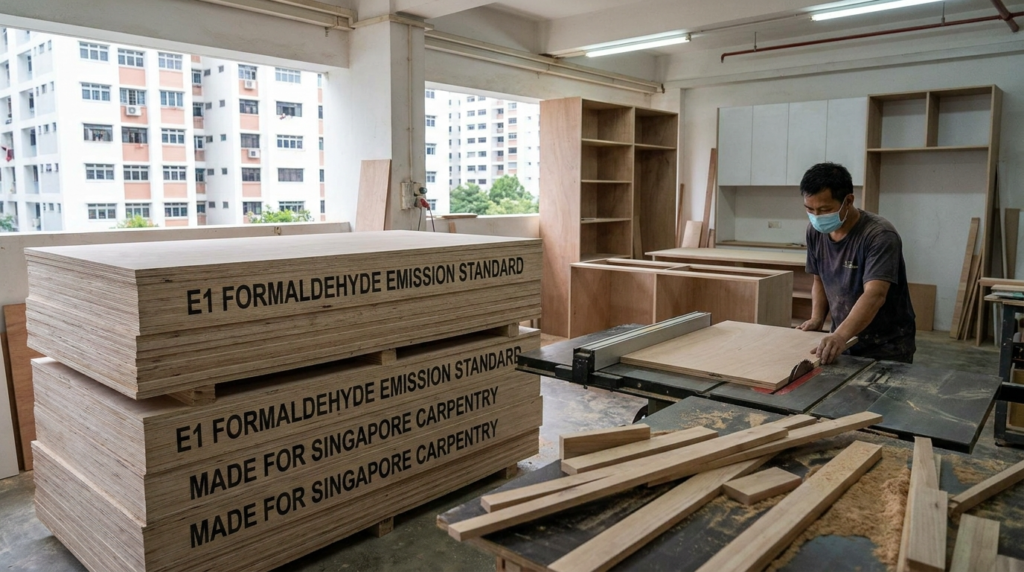
Written by: Hock Star Direct Contractor Team (20+ Years HDB & BTO Experience) Last Updated: April 2026 Low formaldehyde plywood (specifically rated E0 or Super E0) is the safest material for custom built-in carpentry in Singapore. While it costs roughly 15-20% more than standard E2 plywood, it drastically reduces the emission of toxic, cancer-causing VOCs (Volatile Organic Compounds) in your home, protecting your family from respiratory issues. The Danger of Cheap Carpentry in HDBs Custom carpentry—like kitchen cabinets, built-in wardrobes, and feature walls—makes up the bulk of any BTO or resale renovation. To keep prices artificially low, many contractors and IDs use cheap, industrial-grade plywood (E2 grade) bonded with urea-formaldehyde resin. In Singapore’s high heat and high humidity, this cheap plywood undergoes rapid “off-gassing.” This is what causes that sharp, pungent “new house smell” that burns your eyes and throat. Benefits of Low Formaldehyde Plywood Immediate Move-In Safety: Standard carpentry requires you to “bake” the house to clear the toxic gas. Low formaldehyde plywood allows for a safer, faster move-in. Allergy and Asthma Prevention: Formaldehyde is a known irritant that triggers asthma attacks, eczema, and severe respiratory distress. E0 wood virtually eliminates this risk. Long-Term Structural Integrity: Premium E0 plywood generally utilizes higher-quality core veneers and moisture-resistant glues, making it more durable. Frequently Asked Questions (FAQ) Does low formaldehyde plywood cost a lot more? For a standard 4-Room BTO, upgrading your entire custom carpentry package to premium E0 low formaldehyde plywood typically adds $1,500 to $3,000 to the total bill. How can I tell if my contractor is actually using E0 plywood? Reputable direct contractors will be able to show you the manufacturer’s certification stamp directly on the raw plywood boards before the laminate is applied. Conclusion When renovating your forever home, health and safety should never be compromised for a slightly cheaper carpentry quote. Upgrading to E0 or Super E0 low formaldehyde plywood ensures that your built-in wardrobes and kitchen cabinets will look beautiful and keep your family breathing clean, toxin-free air for decades. Disclaimer: The information provided in this article is for educational purposes only. Sensitivities to VOCs and formaldehyde vary by individual. Always verify the plywood grading and material certifications directly with your chosen renovation contractor before commencing carpentry works.
Commercial & Office Renovation Cost Singapore Guide
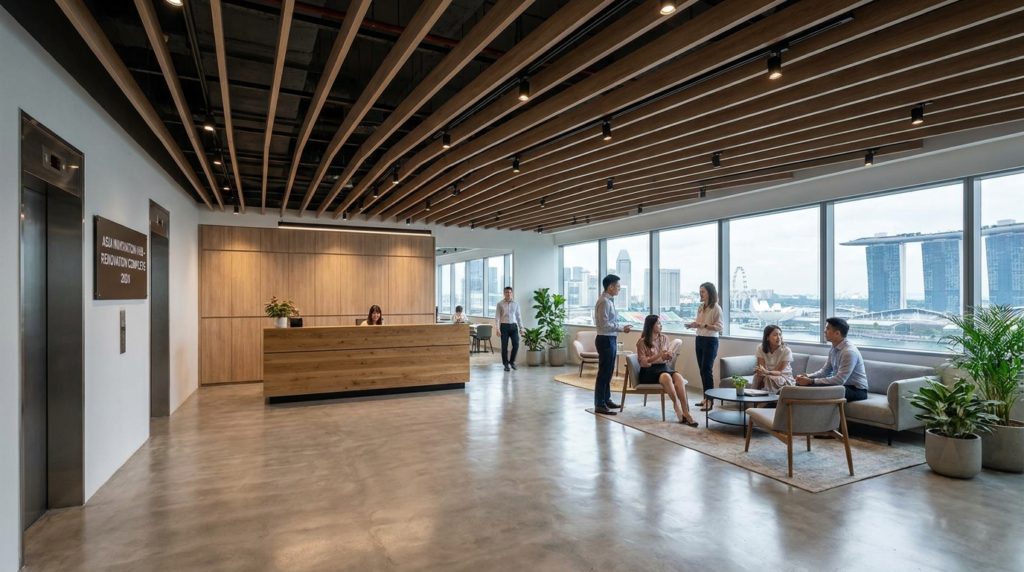
Written by: Hock Star Direct Contractor Team (20+ Years Commercial & Residential Experience) Last Updated: April 2026 In 2026, office renovation costs in Singapore range from $50 to $120+ per square foot (psf), heavily dependent on the building’s MCST requirements, the extent of HVAC/electrical works, and material finishes. A standard 1,000 sqft office will typically cost between $50,000 to $80,000 for a complete, functional fit-out when using a direct contractor. The Hidden Costs of Office Renovation Renovating an office in Singapore is drastically different from an HDB BTO. Business owners often budget for aesthetics but overlook the rigid, compliance-heavy technical requirements of commercial buildings. Working with a direct commercial contractor like Hock Star ensures your budget goes directly into quality materials and certified compliance. Critical Compliance for Commercial Spaces If you are renovating a commercial unit in areas like CBD, Paya Lebar, or Ubi, you must factor in these strict regulatory hurdles: Fire Safety & Shelter Department (FSSD): Any changes to partitions or ceilings require you to reroute fire sprinklers and emergency exit signs. This must be done by certified professionals. Night Works & Hoarding: Most commercial buildings strictly prohibit noisy hacking during the day. Night-shift labor and protective MCST hoarding will marginally increase your baseline costs. Reinstatement Liabilities: When your lease ends, your landlord will require you to “reinstate” (strip down) the office to its original bare state. Frequently Asked Questions (FAQ) How long does an office renovation take in Singapore? For a standard 1,000 to 2,000 sqft office, expect a timeline of 4 to 8 weeks. FSSD and MCST permit approvals can take an additional 2 to 4 weeks. Is it cheaper to use a direct contractor for my office? Yes. A direct contractor has their own in-house electricians, carpenters, and builders, bypassing heavy design and project management markups. Conclusion Budgeting for a commercial office renovation in Singapore requires foresight into compliance, night-works, and mechanical/electrical overhauls. By partnering with an experienced direct contractor, business owners can bypass heavy middleman fees and ensure their office opens on time and strictly up to code. Disclaimer: The information provided in this article is for general informational purposes only. Renovation costs, MCST guidelines, URA approvals, and FSSD fire safety regulations are subject to change. Always consult with a licensed commercial contractor to receive an accurate, customized quotation for your specific office unit.
Aluminium Gates Singapore Guide

Written by: Hock Star Direct Contractor Team (20+ Years HDB & BTO Experience) Last Updated: April 2026 For Singapore HDB and BTO flats, an aluminium gate typically costs between $600 to $1,200, depending on the size (3×7 ft or 4×7 ft) and customization. Unlike traditional mild steel, aluminium is 100% rust-proof, extremely lightweight, and highly compatible with modern smart digital locks, making it the top choice for modern homeowners. Why Choose Aluminium Gates Over Mild Steel? For decades, mild steel was the default standard for HDB gates. However, aluminium gates has rapidly taken over the market for three critical reasons: Zero Rust: Singapore’s high humidity causes mild steel gates to rust over time. Aluminium naturally oxidizes to form a protective layer, meaning it will never rust. Lightweight for Digital Locks: Heavy steel gates can wear out the motors on expensive smart locks. Aluminium is lightweight, putting zero strain on digital lock mechanisms (like Samsung, Yale, or Igloohome). Customizable Finishes: Aluminium can be powder-coated in matte black, textured grey, or wood-grain finishes that perfectly match your BTO’s exterior aesthetic. Popular Aluminium Gate Designs in 2026 At Hock Star Direct Contractor, we install a wide variety of aluminium gates tailored to your privacy and ventilation needs: Laser-Cut Designs: Precision-cut patterns offering a modern, geometric look. Louvered Gates: Angled slats that allow excellent airflow into your HDB living room while preventing outsiders from looking directly inside. Frequently Asked Questions (FAQ) Do I need an HDB permit to change my front gate? No, replacing your main gate does not require an HDB permit, provided the new gate does not swing outwards into the common corridor and obstruct the escape route. Can I install a digital lock on an aluminium gate? Yes. In fact, aluminium is the preferred material for digital locks because its lightweight nature prevents the lock’s latch from dropping or misaligning. Conclusion Upgrading to an aluminium gate is a long-term investment in your home’s security, aesthetics, and convenience. By pairing a rust-proof aluminium frame with a modern digital lock, you ensure hassle-free access and a beautiful entrance to your HDB or BTO flat. Contact Hock Star Direct Contractor today for a transparent, 0% markup quotation. Disclaimer: The information provided in this article is for general informational purposes only. Prices, HDB regulations, and material specifications are subject to change over time. Always consult with a licensed professional or direct contractor for accurate, project-specific quotations and compliance before commencing any renovation works.